
During winter, linnets gather in large flocks across open meadows, hedgerows, and countryside landscapes, where they forage for seeds and occasional insects.
Known for their highly social nature, these birds sometimes even nest in groups, setting up colonies within dense vegetation. The linnet’s melodic song has made it a popular choice for captivity, where it is occasionally bred with canaries.
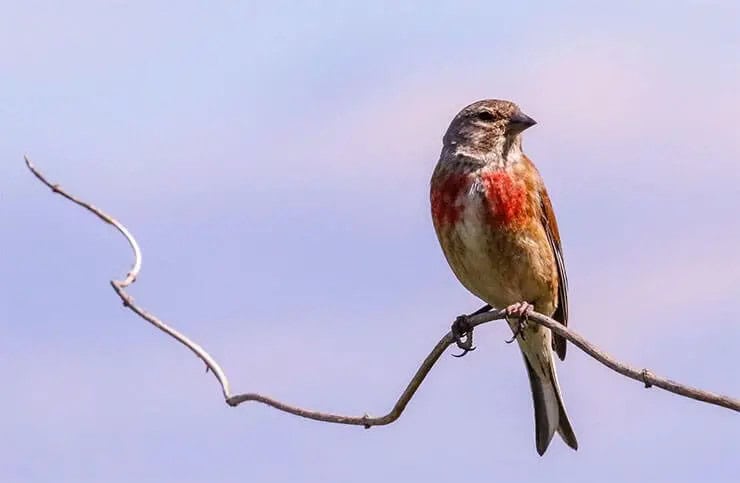
Key Insights into the Linnet
The linnet, unlike many bird species, doesn’t establish an exclusive feeding ground during its breeding season. Instead, these birds share areas with sufficient food, like mowed fields. Each nesting pair defends a 15-meter area around their nest, deterring others from approaching too closely.
Male linnets perch nearby, often high up on bushes or branches, marking and defending their shared territory from intruders.

In winter, linnets move in groups, foraging across grassy fields and bushes. Their small size can make them hard to spot, but their distinct white wing bar and tail markings help identify them in flight.
Quick Facts
- Scientific Name: Linaria cannabina
- Weight: 15–20 g
- Length: 13–14 cm
- Wingspan: 22–25 cm
- Lifespan: Up to 9 years
- Diet: Primarily seeds, occasionally insects
- Habitat: Gravel pits, agricultural fields, mountains, human-populated areas
- Conservation Challenges: Loss of traditional agricultural landscapes, pesticide use, and habitat reduction due to forest expansion
Appearance
During summer, male linnets display tawny shoulders, a grey head with a red crown, and a red-pink chest fading to a white underside. Their tails are blackish with white edges, and their beaks and legs are often grey with a hint of fawn.

In winter, their coloring dulls to brown, with the red fading from the head and chest. Females look similar to winter males but have heavier streaking and less prominent white on the wings.
Distribution
The linnet’s range covers Europe, Asia, and parts of Africa, with seven known subspecies. The Eurasian linnet, Linaria cannabina cannabina, is the most widespread subspecies in Europe and parts of Asia.
Diet and Breeding
A granivorous bird, the linnet primarily consumes seeds, but it will also eat insects. Linnets generally nest near streams or bushes, laying 4-6 pale blue eggs marked with light brown. They raise up to two broods per year, with eggs incubating for about 13 days and young linnets ready to fly at around 15 days.

Conservation Status
Linnet populations in the EU saw moderate declines between 1990 and 2000, with breeding pairs currently estimated at 5-13 million.
This represents about half of Europe’s linnet population and roughly a quarter to half of the global population. In Italy, populations are stable, contributing about 2-3% to the EU total.
To support linnet populations, preserving traditional, low-intensity agriculture in mountainous areas is recommended. Maintaining hedgerows, shrubs, and uncultivated patches in farmlands while limiting pesticide use in areas frequented by linnets could significantly improve their habitat and food sources.
High-altitude areas continue to offer more suitable conditions for linnets compared to lower altitudes, where habitat loss from intensified agriculture and forest spread has had a substantial impact.
Read More Birds