
The White-naped Crane (Antigone vipio) is an elegant bird native to East Asia, with breeding grounds in northeastern Mongolia and northern China and winter habitats in Korea and Japan.
This migratory bird often leads a quiet life in pairs during the breeding season but gathers in large groups while migrating or in winter areas, though its population remains small, estimated at around 6,000.

Unique Courtship and Social Behavior
Known for its distinctive “dance of the cranes,” a characteristic trait shared by crane species, the White-naped Crane’s dance includes jumps, wing flapping, and spinning movements, which are more frequent in winter habitats. Both mature and young cranes participate, creating a captivating sight.
The mating pair also engages in synchronized “duet” displays, where the male lifts his wings and flaps them, while the female keeps hers closed and responds with high-pitched calls. These duets strengthen pair bonds and help signal territory ownership, performed both in breeding and wintering areas.
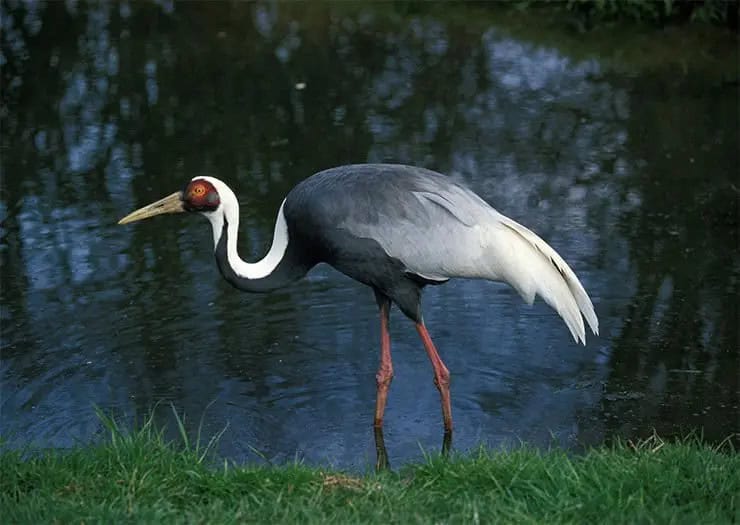
In flight, the White-naped Crane glides with slow, deliberate wingbeats and a direct, quiet motion, rising swiftly from the ground. While it can live up to 25-30 years in the wild, cranes in captivity may reach 45 years or more.
Physical Characteristics
Weighing between 5 to 6 kilograms and measuring 112 to 125 centimeters in length, the White-naped Crane has a wingspan of about 200 to 210 centimeters. Males are slightly larger, although the sexes look similar.
The crane’s predominantly gray feathers are accented with white on the neck and back of the head. Dark feathers cover the primary wings and lower body, contrasting with light gray wing feathers. It has a striking red, featherless patch of skin around its orange eyes, with long, bluish-pink legs.

Newly hatched chicks are covered in yellow-brown down with a mix of gray, while older chicks develop a more uniform reddish-brown. Juvenile cranes show red-brown upper feathers and a pale, whitish throat, with gray lower bodies.
Habitat and Migration
The White-naped Crane breeds in northeastern Mongolia, China, and southeastern Russia. During winter, hundreds reside in the demilitarized zone between North and South Korea, while others migrate to Japan, arriving in October and spending the winter near Izumi on Kyūshū Island before leaving in February.
Diet and Breeding
An omnivorous species, the White-naped Crane feeds on insects, seeds, roots, aquatic plants, and grains. When raising chicks, they may also hunt small animals like rats and frogs.
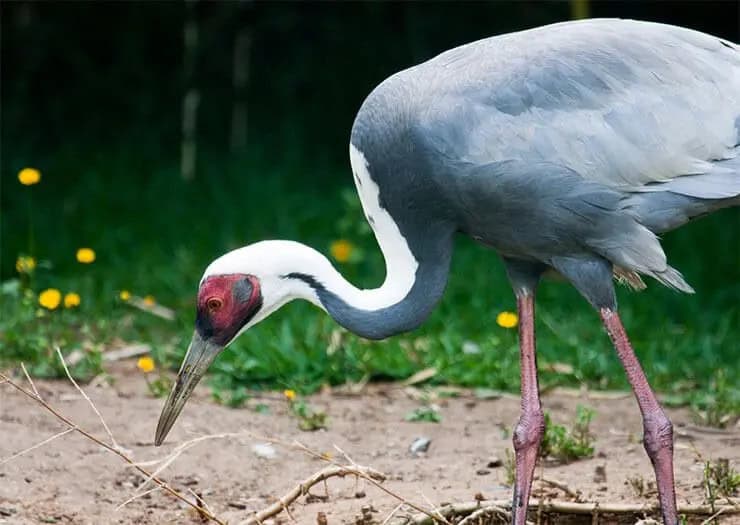
Cranes reach sexual maturity at three to four years old and maintain monogamous bonds across breeding seasons. They return to partially frozen breeding grounds in early spring, defending territories against intruders.
Nests are built in open marshes with shallow water, constructed from grass, moss, and sedges. The nest’s interior remains dry, insulated with leaves, and is often reused each year.
The female lays two reddish-speckled eggs in late April or early May, which hatch after 30 days. Chicks are typically self-sufficient by 75 days, though scarcity of food may mean only one survives to maturity.

Conservation Status and Efforts
Classified as Vulnerable on the IUCN Red List, the White-naped Crane’s numbers have dwindled, with fewer than 6,500 estimated in the wild. Conservation programs, like those at Khingan Nature Reserve, use eggs from U.S. zoos to help boost population numbers.
The crane’s wintering areas were heavily impacted by World War II and the Korean War, and ongoing habitat loss and poaching continue to pose threats to this rare and graceful species.
Read More Birds