
Historically, the black redstart was mostly found in rocky regions. However, urban development in the 18th and 19th centuries encouraged this bird to adapt, leading it to settle in plains, villages, and cities.
Today, it is a familiar presence across Europe, where it often nests at altitudes up to 3,200 meters. Its distinct, shrill song begins just before dawn, signaling the start of a morning chorus.
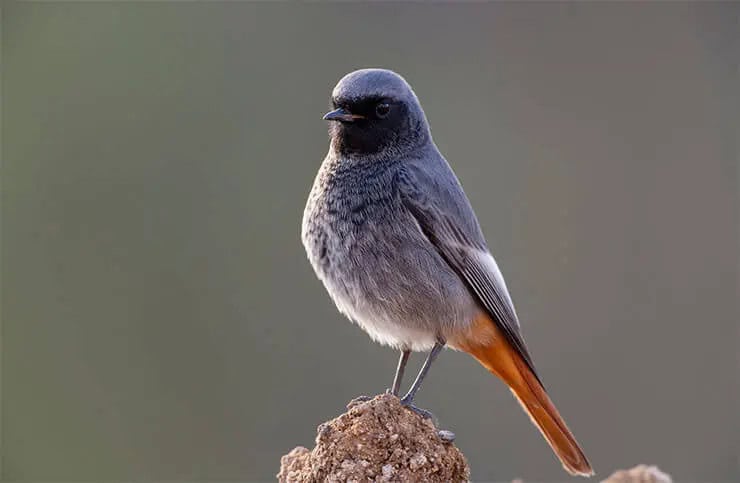
All About the Black Redstart
Surprisingly, the black redstart (Phoenicurus ochuros) holds one of the broadest ranges across the European Alps.
Recognized by its black body and red tail, this bird has adapted well to urban life, making homes out of buildings, from castles to warehouses. You’ll often spot it singing on a wire or perched atop an antenna.
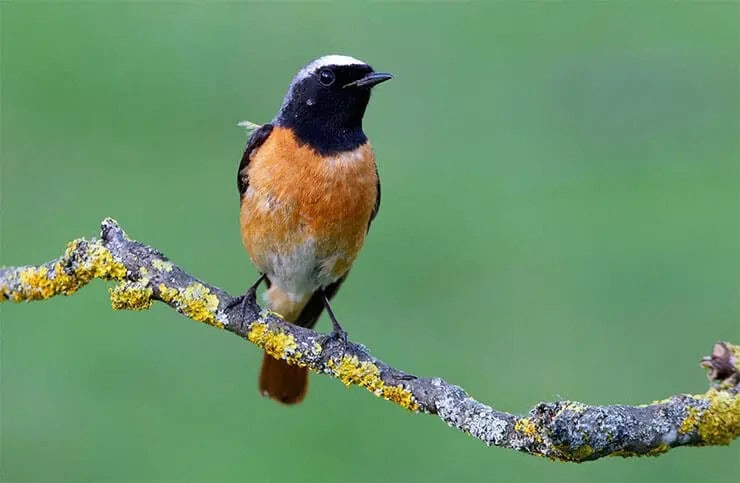
The black redstart is a clever, adaptable bird frequently seen on rooftops, chimneys, and antennas. At night, it retreats to small crevices in walls or rock cavities. When on the ground, it hops rather than walks, and its tail is in constant motion.
Observing the black redstart requires little effort; they are visible in alpine villages and even large cities. These lively birds are comfortable around people, typically flying off only if approached too closely.
Quick Facts
- Scientific name: Phoenicurus ochuros
- Weight: 14 – 19 g
- Length: 13 – 15 cm
- Wingspan: 23 – 26 cm
- Lifespan: Up to 10 years
- Diet: Primarily insects, small crustaceans, and berries
- Habitat: Urban areas and mountainous regions
- Threats: Expanding forests due to abandoned farmland, which reduces the open spaces the bird prefers
Key Traits
The black redstart is a small passerine bird, weighing under 20 grams, with a wingspan of 23 to 26 cm. Its distinguishing feature is its red tail, shared by both sexes.

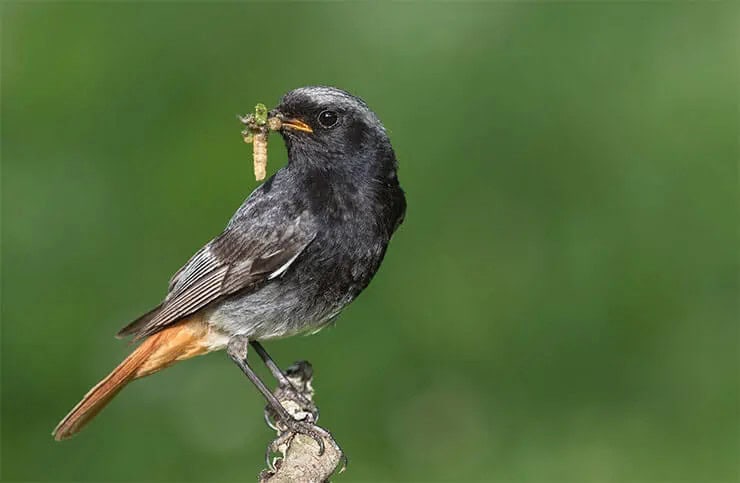
However, males are predominantly black with a white wing patch, while females are brownish-gray without the wing spot. Its song is short and marked by “tsip” and “tictic” sounds.
Habitat and Distribution
The black redstart thrives in mountainous regions during the summer, reaching altitudes up to 2,600 meters in the Alps. Asian populations can reach 5,000 meters in the Himalayas.
While the species originally inhabited only mountains, it now descends to lower areas during winter, adapting well to urban environments, especially in smaller towns and suburban areas. It can also be found in large cities, often nesting on tall buildings.
This bird’s range covers Europe, Asia Minor, and Tibet. During winter, northern European populations migrate to warmer regions, including the Mediterranean and North Africa.
It’s generally absent from parts of the British Isles and Scandinavia, while one subspecies, Phoenicurus ochruros rufiventris, ranges eastward to Iran and China.
Diet
The black redstart primarily consumes insects, especially flies and butterflies, which it often catches mid-flight. Its diet also includes berries and, in coastal areas, small crustaceans.
Breeding
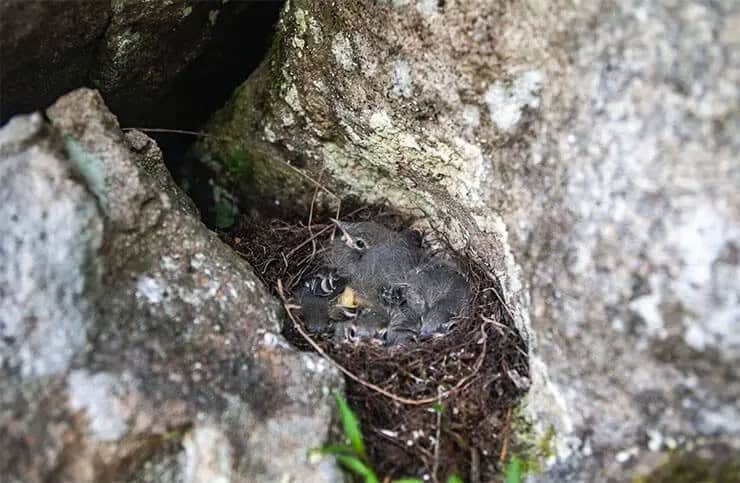
The breeding season begins in May. Black redstarts typically build their nests in mountain rock crevices or on city buildings, using dried grass, feathers, roots, and moss.
They are monogamous, with females laying four to seven smooth, white eggs. Both parents care for the chicks, who leave the nest about a month after hatching.
Conservation Status
The black redstart is classified as a protected species within the European Union and faces no immediate threats.
Between 1970 and 1990, as well as in the following decade, its population remained stable, with around 2.6 to 5.9 million breeding pairs in the EU and 4 to 8.8 million pairs across the continent. While southern populations are mostly sedentary, northern groups migrate seasonally.
Despite a stable population, localized threats from environmental changes—such as reduced agro-pastoral land use—highlight the need for conservation efforts, particularly in mountainous areas and regions affected by human development.
Read More Birds