
Often mistaken for a duck, the Eurasian coot is a fascinating wading bird with distinctive features and behaviors. Unlike ducks, coots are notable for their splayed toes instead of webbed feet, setting them apart among waterfowl.
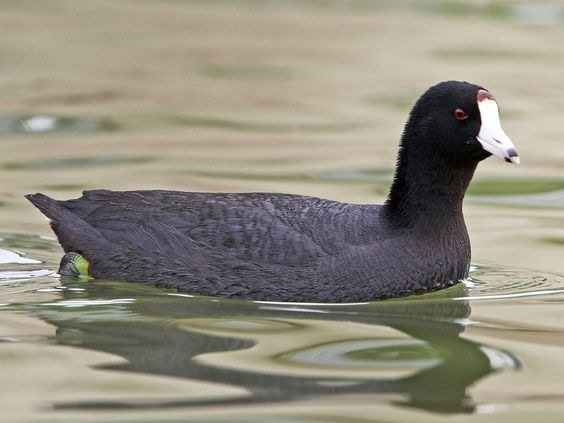
An adult male Eurasian coot is distinguished by its black head and neck, dark grey body, and striking red eyes. During flight, white-tipped secondary feathers create a vivid contrast against its wings.

Its white bill extends into a white facial shield above the eyes and onto the forehead, resembling the face shield seen on the Common Moorhen.
Females have a similar appearance to males, though they are slightly smaller, while juveniles have brownish-grey feathers with a greyish-white throat, paler underparts, and a yellowish bill. This range of plumage adds to the bird’s visual appeal.

Eurasian coots are also known for their distinctive calls. Males often produce sharp, metallic sounds, like “kick” or “kick-kick,” adding to their communicative variety and assisting with territory establishment and mate attraction.
In feeding, coots show unique behavior compared to ducks. While ducks consume food underwater, coots surface to eat. Their mostly vegetarian diet consists of aquatic plants, algae, and grasses, though they will eat small creatures like tadpoles. With large, pale grey feet and broad toes, they can dive effectively to reach the lakebed for food.
These birds are widely distributed across Europe, Asia, parts of Africa, Indonesia, Australia, and New Zealand. In winter, many Eurasian coots migrate from northern and eastern Europe to warmer regions like sub-Saharan Africa and Southeast Asia.

Breeding is a collaborative effort between male and female coots, who build nests from reeds, leaves, roots, and twigs near vegetation or under tree branches.
The incubation lasts around twenty-one to twenty-six days, and both parents care for their six to ten eggs. Young coots fledge roughly fifty-five to sixty days after hatching.
With its unique appearance, vocalizations, and habits, the Eurasian coot stands out among wading birds. Found in lakes, ponds, and sometimes even saltwater estuaries, the coot is a reminder of nature’s diversity and beauty.
Next time you see a wading bird that resembles a duck, take a second look—it might be the remarkable Eurasian coot, offering a glimpse into the fascinating world of waterbirds.
Read More Birds