
In a charming video captured in October 2021, two newborn tiger cubs explore and play with their mother at Banham Zoo in Norwich, UK.
One of the playful Amur tiger cubs is shown climbing onto its mother’s back, eventually reaching her head.
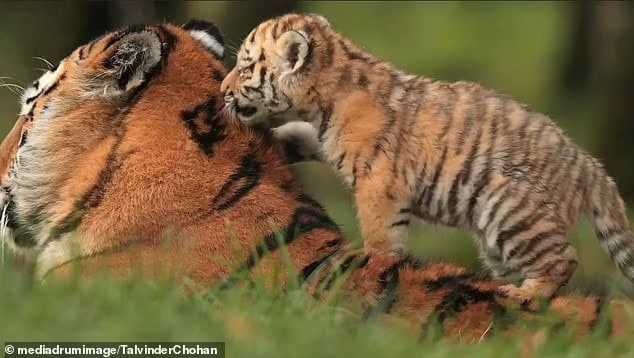
The mischievous cub even tries to nibble on her ears, disrupting her attempts to sleep. After some playful antics, the cub leaps off its mother’s back and scampers away.
This tiger family lives at Banham Zoo, where they are frequently observed by visitors and photographers alike.
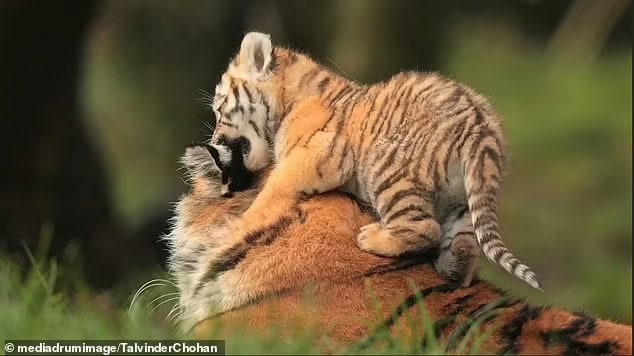
Talvinder Chohan, a 40-year-old business development manager, and photographer, captured additional footage showing the cubs napping on their mother’s back.
Suddenly, they are startled awake, and one cub tries to settle down again but quickly loses interest, dashing off through the grass.
Reflecting on the experience, Chohan remarked, “Wildlife and zoo photography requires a lot of patience because you are working on the animal’s terms. Through observation and experience, you can start to predict certain behaviors. I admire how the tigress, despite her strength, is so gentle. Images like these help people connect with and appreciate tigers, which is crucial for their conservation.”
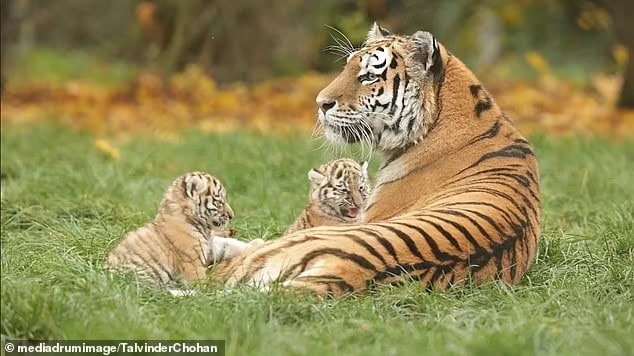
Amur tigers, such as the cubs in the video, are endangered. These powerful creatures can live up to 20 years, grow up to 80 inches long, with tails reaching an additional 30 inches, and can weigh as much as 670 pounds. Once, there were nine subspecies of tigers, but three became extinct in the last century.
Amur tigers, sometimes known as Siberian tigers, primarily reside in the birch forests of Russia, with some populations also found in China and North Korea.
Despite their endangered status, conservation efforts have led to slight population recoveries, especially for Bengal tigers in India.
However, Amur tigers face significant threats, including poaching, habitat loss, and human-animal conflict.
Chohan noted that while the tigers at Banham Zoo are in captivity, it is important to maintain a respectful distance to avoid disturbing them.
“I felt like I captured something special,” he said, “and the positive response on social media confirmed that feeling. There’s hope for these magnificent animals, but their challenges remain.”
Read more Wildlife News.


