
The helmeted guineafowl, while widely bred in Europe, is primarily native to Africa, where it thrives in the wild. Though not typically known as a pet, this bird has been valued historically for its meat.
Its appeal as a food source initially brought it to Europe, and eventually to the Middle East and the Americas, where it’s now a staple on farms rather than seen as a game.

Historical Significance and Reintroduction
If you’re considering breeding helmeted guineafowl, it’s essential to know they belong to the Numida genus, with several species spread across Africa.
Today’s commonly raised guineafowls belong to the Numida meleagris species. In ancient Rome, guineafowl, likely from North Africa, became widespread throughout the empire.
However, with Rome’s decline, these birds largely vanished from Europe until the Portuguese reintroduced them from African colonies. They later found their way to the Americas, where they adapted well to new environments.
Unique Hybrid Potential
Helmeted guineafowls can sometimes interbreed with other galliformes, producing striking but generally sterile hybrids. Known hybrids include those between guineafowls and roosters, with rarer instances of crosses with peacocks.
Scientific Classification: Numida meleagris
Weight: 1–2 kg
Wingspan: 25–28 cm
Lifespan: Up to 15 years
Diet: Omnivorous—includes fruits, seeds, greens, insects, and small vertebrates
Habitat: Varied, from forests and prairies to semi-desert and bushy areas
Threats: Habitat loss, hunting, disturbances from human activity, cats, and dogs
Physical Appearance
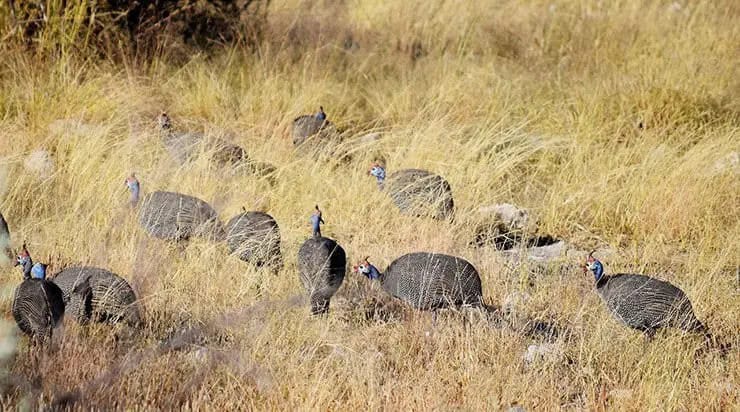
The helmeted guineafowl’s plumage is dark with light spots, resembling “pearls” or teardrops. According to Greek mythology, these spots symbolize the tears of Meleager’s mourning sisters, transformed by the gods into guineafowls.
Physically, they have bare heads with red wattles and a crest, which gives them their name. Domestic males can weigh up to 1.8 kg, while females often surpass 2 kg.
In contrast, wild guineafowls rarely exceed 1.1 kg. Differences in the sexes are subtle, with females having larger pectoral muscles, while males display a stiff, upright stance when walking.
Habitat and Adaptability
Helmeted guineafowls are highly adaptable, living in diverse environments from African savannas to European farms. Their original habitat lies south of the Sahara, where they favor warm, dry areas with sparse vegetation.
Though adaptable to many environments, they tend to be sedentary and thrive in groups, often roosting in trees and foraging collectively to find food and evade predators.
Diet and Social Behavior
Non-migratory and gregarious, helmeted guineafowls stay within a chosen territory and roost together at night. They are often seen in flocks of 20-25 individuals, foraging for tubers, berries, and insects. Gathering as a group not only increases their food supply but also offers protection. They drink primarily at night, often communally.
Reproduction
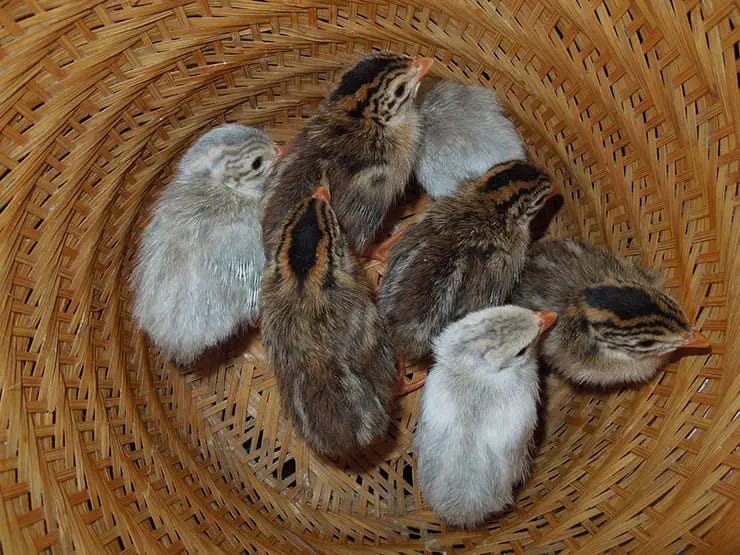
Helmeted guineafowls are monogamous, with pairs mating for life. They nest by digging shallow depressions in the ground, filled with natural materials to form a secure nest. Females lay 5-8 hard-shelled eggs, which they incubate for about 25 days while the male guards the nest.
Both parents care for the young until they can survive independently. In captivity, guineafowls require spacious coops, as they can become aggressive if confined too closely.
Conservation Status
With a population exceeding 1 million, helmeted guineafowls are currently classified as “Least Concern” on the IUCN Red List, indicating a stable global population.
However, their numbers can be impacted by habitat loss, hunting, and disturbances from human activities, as well as from domestic animals like cats and dogs.
Read More Birds
