
The Southern Grey Shrike (Lanius meridionalis) stands out as one of the most unique bird species, thanks to its unusual hunting habits. Often found across the Iberian Peninsula, parts of France, and western Italy, this bird’s behavior is remarkable yet remains lesser known.
An Overview of the Southern Grey Shrike
Shrikes, including the Southern Grey Shrike, share a distinctive feature: their small size is offset by a hooked beak, similar to that of larger birds of prey. This adaptation supports their hunting habits, which include catching insects and, in the case of the Southern Grey Shrike, even small vertebrates like rodents, lizards, and other birds.

The name “shrike” comes from the Latin word lanius, meaning “butcher,” reflecting their dramatic hunting style. Belonging to the Laniidae family, the Southern Grey Shrike is native to Africa, Asia, and Europe, with some related species also present in North America, Australia, and South America.
This species, once considered a subspecies of the Northern Grey Shrike, is now recognized as distinct, especially due to its Mediterranean habitat, which includes large parts of North Africa, the Middle East, the Iberian Peninsula, and areas of France near the Italian border.

Key Characteristics
- Scientific Name: Lanius meridionalis
- Size: 22-26 cm in length, with a wingspan of 30-34 cm
- Weight: 55-80 g
- Diet: Insects, small mammals, reptiles, birds, and amphibians
- Habitat: Farmlands, hedges, swamps, and wetlands
- Threats: Habitat loss due to changing land use
Appearance and Behavior
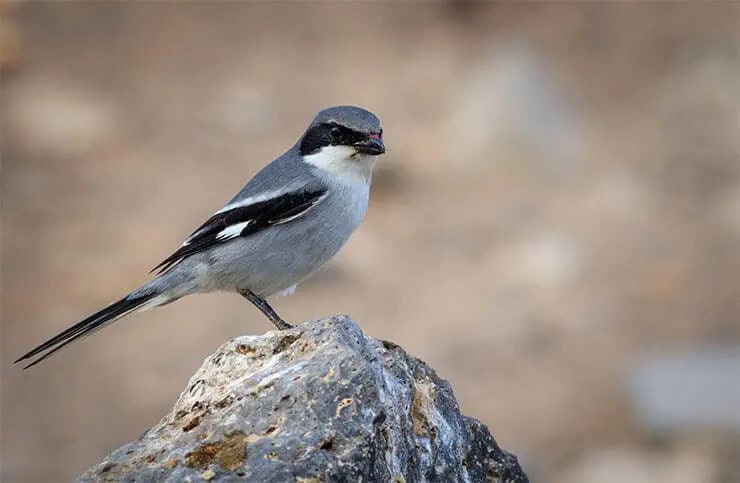
The Southern Grey Shrike is the largest shrike species in the Iberian Peninsula. It thrives in open, dry areas across the Mediterranean, including the Canary Islands. Its distinctive look includes a sturdy build, long tail, and a striking black “mask” around the eyes.
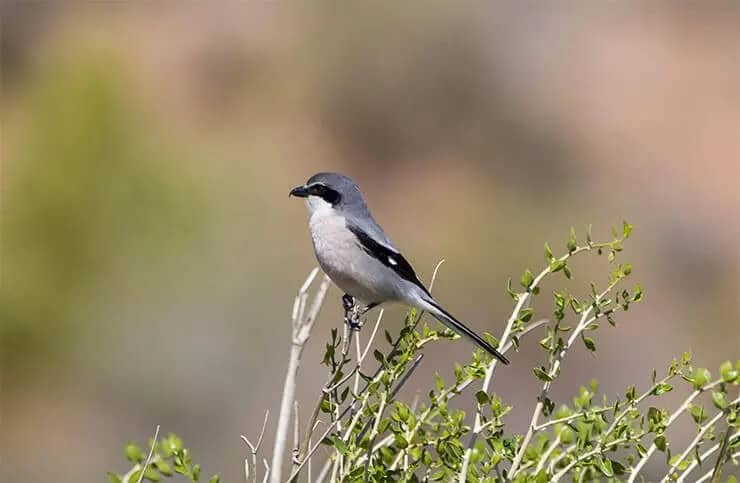
Black wings with a prominent white patch and its mostly grey body make it easy to spot. This bird’s metallic, powerful song is also noteworthy, as it can mimic other birds. Typically around 25 cm in size, it boasts an impressive wingspan exceeding 30 cm.
Distribution and Habitat
This species has several subspecies but is sparsely distributed across southern Europe, including limited areas in France, Portugal, Italy, and Spain.
It is also present in North Africa, the Canary Islands, and some regions in Asia. Preferring open spaces, the Southern Grey Shrike is often seen perched on wires or poles, scanning the area for prey.
In Italy, it’s found only in the westernmost regions. Estimates suggest there are over 500,000 individuals in southwestern Europe, though their numbers are slowly decreasing.
Diet and Hunting Style
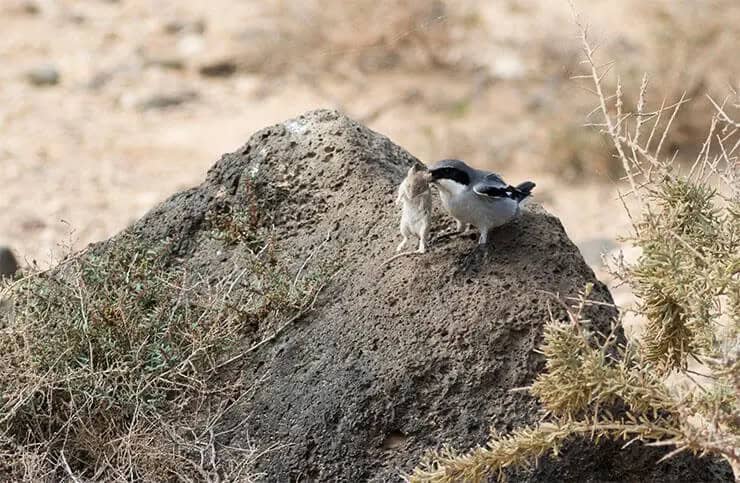
The Southern Grey Shrike’s hunting method is unique: it often impales its catch on thorns or barbed wire before tearing it apart with its beak, earning it the nickname “butcher bird.” Typically, it hunts from a high perch, waiting for the right moment to strike and secure its prey on sharp branches.
Breeding
Breeding usually begins in March in southern Europe, though it starts earlier in Africa and the Canary Islands. These birds lay up to seven eggs, which are white with black spots, in nests built in thorny bushes. The chicks hatch after about two weeks.
Conservation Status
The Southern Grey Shrike’s population has been steadily declining across the European Union, with significant reductions from 1970-1990 and smaller declines in the following decade. The EU population is estimated at 240,000-360,000 pairs, representing up to 96% of the continental population.
To aid this species, conservation efforts need to focus on preserving open habitats like meadows, wetlands, and areas with ample perches. Reducing human disturbance, especially in wintering sites, could also support stable populations of this distinctive bird.
Read More Birds
