
Known as the little heron or mangrove heron, the striated heron is commonly found in mangrove forests across Oceania, Central and South America, Asia, and South Pacific island nations.
Part of the Ardeidae family, this bird is remarkable for its unique hunting methods and its ability to coexist with humans despite urban development in its habitat.

A Clever and Cautious Predator
The striated heron, with its long legs and distinctive stance, is a surprisingly skilled hunter. This bird often uses bait to catch fish—dropping small objects into the water to lure fish close enough to snatch.
While relatively tolerant of human presence, the striated heron is a shy bird that retreats to secluded mangroves when not actively hunting.

Its hunched posture and muted colors allow it to blend seamlessly into dense vegetation, making it easy to miss. A stealthy hunter, the striated heron often remains motionless at the water’s edge until it strikes with lightning speed to catch its prey.
Quick Facts About the Striated Heron
- Scientific Name: Butorides striata
- Weight: 200–250 g
- Length: 40–48 cm
- Wingspan: 62–70 cm
- Diet: Primarily fish and shellfish, but also insects, spiders, and occasionally small mammals and reptiles
- Habitat: Mangrove forests, rivers, estuaries, ponds, mudflats, coral reefs, and tidal zones
Appearance
From a distance, the striated heron can appear entirely dark, but closer inspection reveals gray-blue wings, a white underside, and a black cap on its head. A dark stripe connects the bill and eye, and the heron’s legs are a distinct yellow.
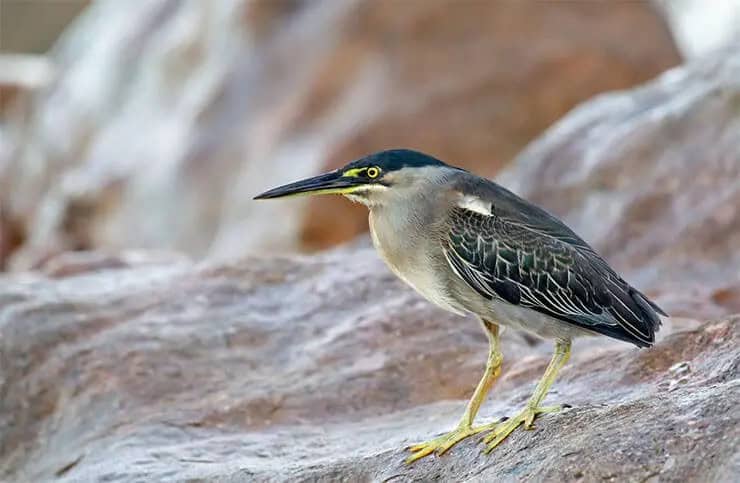
Younger birds display brown upper parts with streaked undersides. Unlike larger herons, the striated heron prefers solid ground and often waits patiently at the water’s edge for fish and amphibians to come near.
Range and Habitat
Striated herons are largely sedentary, residing from South America up through Central America, Africa, Southern Asia, and into Oceania, including as far north as Japan and Korea and as far south as Polynesia and Australia.
Diet and Hunting Techniques
Striated herons primarily hunt at dusk or dawn, feeding on small fish, frogs, leeches, and sometimes even mice. Known for their low tolerance of other birds while hunting, they often stand still at the water’s edge, striking swiftly with their long necks to capture prey. Their remarkable baiting technique involves dropping food or insects into the water to attract fish.

Breeding Habits
Around September, northern populations migrate to warmer winter locations, while the mating season for most occurs from March to May, depending on rainfall and food availability.
During the mating season, male herons court females with loud, display-filled flights and select nesting sites in marshes or forested areas near water.
Nests are usually platforms of twigs, often in trees, though occasionally found on the ground. Both parents share in incubation and feeding duties, with young herons leaving the nest after about 16 days but remaining dependent until they can fly at around 30–35 days. In tropical regions, these herons sometimes breed twice a year.
Conservation Status
The striated heron is classified as “Least Concern” by the IUCN, thanks to its extensive range and relatively stable population. However, habitat loss from mangrove destruction and pollution poses a risk, leading to a slow population decline that, while not critical, underscores the importance of protecting their environment.
Read More Birds
